Table of Contents
Curve - DeFi Stablecoin Exchange & Liquidity Protocol
Curve offers efficient stablecoin trading with minimal slippage on Ethereum. Access deep liquidity pools, earn yield through LP tokens, and swap assets with advanced AMM technology. Trade DeFi assets now!
Crypto CoinBlockchainCrypto Directory
Directory Categories
Explore in:Dex Exchange
What is Curve?
Curve is a decentralized exchange (DEX) protocol specifically optimized for stablecoin trading and low-slippage swaps on Ethereum and other blockchain networks. Unlike traditional AMMs that treat all assets equally, Curve uses specialized algorithms designed for assets that trade close to parity—like stablecoins (USDC, USDT, DAI) and wrapped tokens (wBTC, renBTC). This innovative approach enables traders to exchange large volumes with minimal price impact while liquidity providers earn consistent yields. Featured on aitop-tools.com, Curve has become the go-to infrastructure for DeFi users seeking capital-efficient trading and passive income opportunities through liquidity provision.
How to Use Curve
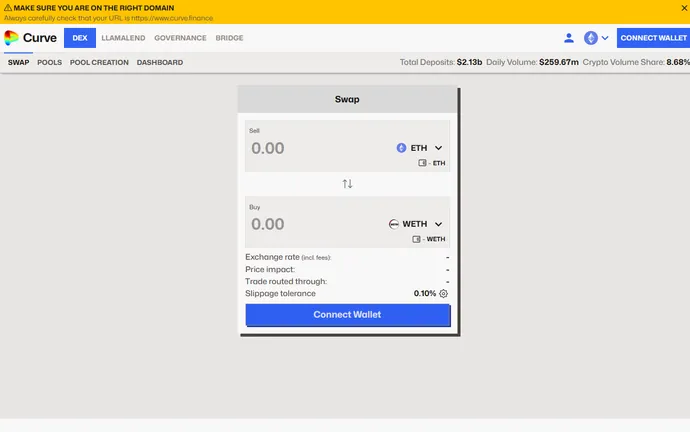
Curve offers intuitive functionality that connects directly to your Web3 wallet like MetaMask or WalletConnect. Simply navigate to curve.fi, connect your wallet, and select the assets you want to swap. The interface displays real-time exchange rates, estimated slippage, and transaction fees before you confirm. For swapping, choose your input and output tokens, enter the amount, and execute the trade—Curve's smart contracts handle the rest with optimized routing across multiple pools for the best rates.
For more comprehensive crypto coin information, visit our explore blockchain navigation page to discover additional blockchain navigation resources and crypto tools.
Key Features of Curve
- Stableswap Algorithm: Curve's proprietary market-making formula dramatically reduces slippage for correlated assets, making it possible to swap millions of dollars in stablecoins with price impacts under 0.1%—far superior to standard AMMs.
- Deep Liquidity Pools: With billions in total value locked (TVL), Curve pools offer unmatched depth for stablecoin and wrapped asset trading, ensuring professional-grade execution for both retail and institutional traders.
- Multi-Asset Pool Support: Beyond simple pairs, Curve supports metapools and factory pools with 3-5 assets, enabling complex trading routes and maximizing capital efficiency for liquidity providers.
- CRV Tokenomics & Governance: Earn CRV tokens through liquidity mining, lock them as veCRV to boost rewards up to 2.5x, and participate in DAO governance to influence pool emissions and protocol decisions.
- Cross-Chain Compatibility: Access Curve pools across 10+ blockchain networks with consistent user experience, allowing you to optimize for gas costs and ecosystem preferences while maintaining the same trusted protocol.
- Permissionless Pool Creation: The Curve Factory enables anyone to deploy custom liquidity pools with tailored parameters, fostering innovation and expanding the protocol's reach to emerging assets.
Each feature connects directly to tangible benefits: traders save money through reduced slippage, liquidity providers earn higher APYs compared to traditional AMMs, and DeFi protocols integrate Curve as critical infrastructure for their own products.
Why Choose Curve?
Curve stands as the industry-leading solution for efficient stablecoin trading, trusted by DeFi protocols like Convex, Yearn Finance, and institutional traders managing millions in assets. The protocol's battle-tested smart contracts have secured billions without major exploits since 2020, while its concentrated liquidity approach delivers execution quality that outperforms competitors by measurable margins. For traders, this means better prices on large swaps; for liquidity providers, it translates to sustainable yields from both trading fees and reward emissions.
The platform integrates seamlessly with the broader DeFi ecosystem through composability—your Curve LP tokens can be used as collateral in lending protocols, staked in gauge systems, or wrapped in yield aggregators for automated strategy optimization. This flexibility, combined with active governance through the Curve DAO, positions the protocol as a cornerstone of decentralized finance infrastructure rather than just another DEX. Whether you're a yield farmer optimizing returns, a trader executing large stablecoin conversions, or a protocol building on reliable liquidity, Curve provides the advanced technology and network effects that define professional DeFi operations.
Use Cases and Applications
Stablecoin Arbitrage and Treasury Management: Corporate treasuries and DeFi protocols leverage Curve to rebalance stablecoin holdings with minimal cost. When managing multi-million dollar portfolios across USDC, USDT, and DAI, Curve's low slippage enables efficient reallocation that would be cost-prohibitive on standard DEXes. Arbitrage traders also monitor Curve pool balances to capture temporary imbalances between stablecoin prices across different platforms.
Wrapped Asset Bridging: Bitcoin holders use Curve's wBTC/renBTC/sBTC pools to seamlessly move between different Bitcoin representations on Ethereum without returning to centralized exchanges. This reduces custodial risk and enables efficient participation in DeFi lending and yield farming using Bitcoin-backed assets. Similar pools exist for Ethereum staking derivatives like stETH and rETH.
Liquidity Mining Strategies:
Explore our crypto directory hub to access a complete collection of crypto coin platforms and blockchain navigation services.
Frequently Asked Questions About Curve
What makes Curve different from Uniswap or other DEXes?
Curve specializes in stablecoin and correlated asset trading using a custom StableSwap algorithm that provides significantly lower slippage compared to standard constant product AMMs like Uniswap. While Uniswap works well for volatile asset pairs, Curve excels when trading assets that should maintain similar prices, offering 5-10x better execution on large stablecoin swaps.
How do I earn yield as a Curve liquidity provider?
Deposit assets into a Curve pool to receive LP tokens representing your share. These tokens automatically earn trading fees from swaps. For additional rewards, stake your LP tokens in Curve gauges to earn CRV token emissions. You can further boost these rewards by locking CRV as veCRV, potentially increasing yields by up to 2.5x.
Is Curve safe to use? Has it been audited?
Curve's smart contracts have undergone multiple security audits from leading firms including Trail of Bits and Quantstamp. The protocol has secured billions in TVL since 2020 with a strong security track record. However, as with all DeFi protocols, smart contract risk exists, and users should only invest what they can afford to lose. Always verify you're interacting with the official curve.fi domain.
What is veCRV and why should I lock my CRV tokens?
veCRV (vote-escrowed CRV) is obtained by locking CRV tokens for up to 4 years. This gives you voting power in Curve DAO governance, allows you to earn a share of protocol trading fees, and boosts your liquidity mining rewards. The longer your lock period, the more veCRV you receive. Many users leverage protocols like Convex to access veCRV benefits without directly locking tokens.
Which blockchain networks does Curve support?
Curve operates on Ethereum mainnet plus multiple Layer 2 and alternative chains including Polygon, Arbitrum, Optimism, Avalanche, Fantom, Harmony, and others. Each deployment maintains the same core functionality but with network-specific gas costs and available pools. You can bridge assets between chains using standard bridge protocols before accessing Curve on your preferred network.
How do Curve Factory pools work?
Curve Factory allows anyone to deploy permissionless liquidity pools with custom parameters without requiring DAO approval. These pools use proven Curve algorithms but can support any ERC-20 tokens. While Factory pools offer flexibility, they typically have lower liquidity and may not receive CRV emissions unless voted for through governance. Always research pool composition and liquidity depth before providing.
What are metapools and tricrypto pools?
Metapools pair a single token against an existing Curve LP token (like 3pool), enabling new assets to access deep liquidity without fragmenting the ecosystem. Tricrypto pools support three volatile assets (like BTC/ETH/USDT) using a different algorithm optimized for non-correlated assets. These specialized pool types expand Curve's utility beyond pure stablecoin trading.
Can I lose money providing liquidity on Curve?
Yes, liquidity providers face impermanent loss risk when pool assets diverge in price, though this risk is minimal for stablecoin pools. If one stablecoin depegs (like USDC dropping to $0.95), your pool position will shift toward holding more of the depegged asset. Smart contract risk and potential exploits also exist. Stablecoin pools generally have much lower IL risk compared to volatile asset pools on other DEXes.
How does Curve's gauge voting system work?
veCRV holders vote every two weeks to determine which liquidity pools receive CRV emissions in the following period. Pools with more votes get higher emission rates, attracting more liquidity. This creates a dynamic governance ecosystem where protocols often accumulate veCRV (or use vote markets like Votium) to direct emissions to their preferred pools, a phenomenon known as the "Curve Wars."
What fees does Curve charge for swaps?
Curve pools typically charge 0.04% trading fees for swaps, significantly lower than most DEXes. Half of these fees go to liquidity providers, while the other half goes to veCRV holders. Some pools may have different fee structures. Additionally, you'll pay blockchain gas fees (which vary by network) and may incur minor slippage on very large trades.
How do I connect my wallet to Curve?
Visit curve.fi and click the "Connect Wallet" button in the top-right corner. Curve supports MetaMask, WalletConnect (for mobile wallets), Coinbase Wallet, Ledger, and other Web3 wallet providers. Select your wallet type, approve the connection request, and ensure you're on the correct blockchain network for the pools you want to access.
What is the relationship between Curve and Convex Finance?
Convex Finance is a protocol built on top of Curve that allows liquidity providers to earn boosted CRV rewards without locking their own tokens. Convex aggregates veCRV voting power from users, applies maximum boost to deposited Curve LP tokens, and distributes rewards as CRV plus additional CVX tokens. Many users prefer Convex for its simplified yield farming with maintained liquidity flexibility.
Can I use Curve for regular crypto trading like BTC/ETH?
While Curve primarily focuses on stablecoins and correlated assets, tricrypto pools do support volatile pairs like BTC/ETH/USDT. However, for general cryptocurrency trading with diverse pairs, traditional AMMs like Uniswap or SushiSwap may offer better execution. Curve's strength lies in efficient stablecoin swaps and wrapped asset exchanges where its specialized algorithm provides clear advantages.
What are the risks of using Curve's cross-chain deployments?
Each Curve deployment on different chains carries network-specific risks including bridge vulnerabilities (when moving assets between chains), varying levels of smart contract auditing, and different liquidity depths. Ethereum mainnet has the longest track record and deepest liquidity, while newer chains may offer lower gas fees but potentially higher risk. Always verify official contract addresses and use trusted bridge providers.
How can I track my Curve positions and earnings?
The Curve dashboard shows your current LP positions, claimable rewards, and staked gauges. For more detailed analytics, use third-party tools like DeBank, Zapper, or Zerion which aggregate your DeFi positions across protocols. These platforms display your total Curve exposure, historical earnings, and impermanent loss calculations. Always verify transaction history on blockchain explorers like Etherscan for authoritative records.
Need more crypto resources? Check out our bitcoin tools collection for bitcoin tools and additional crypto coin services in our crypto directory.